Strat Headstock Fit: 4 Simple Checks for No-Drill Installation
Strat headstock fit is the real question behind a common upgrade idea: if your guitar has six tuners in a row, can you add an automatic tuner without drilling new holes or changing the headstock? Sometimes yes, but not because it looks like a Strat from the front. The deciding factors are on the back of the headstock, where tuner-hole spacing, mounting orientation, PCB alignment, and available clearance all have to match the correct system.
For many readers, fit is easier to judge from a printed template than from the front shape alone.
It also helps to know what an automatic tuner actually is. A system such as TronicalTune combines pitch detection with motorized tuning adjustment. In other words, it does not just tell you whether a string is sharp or flat. It listens to each string, calculates the correction, and turns the machine heads automatically. That is very different from a clip-on, pedal, or phone tuner, which only detects pitch and leaves all turning to your hand.
For a six-in-line guitar, the good news is that compatible installations are designed to avoid drilling, gluing, or routing. The important limit is that this only applies after the exact fit has been confirmed. A headstock that seems obviously Strat-style can still fail a fit check if one or more tuner holes, the rear outline, or the left-to-right orientation do not line up with the intended mounting board.
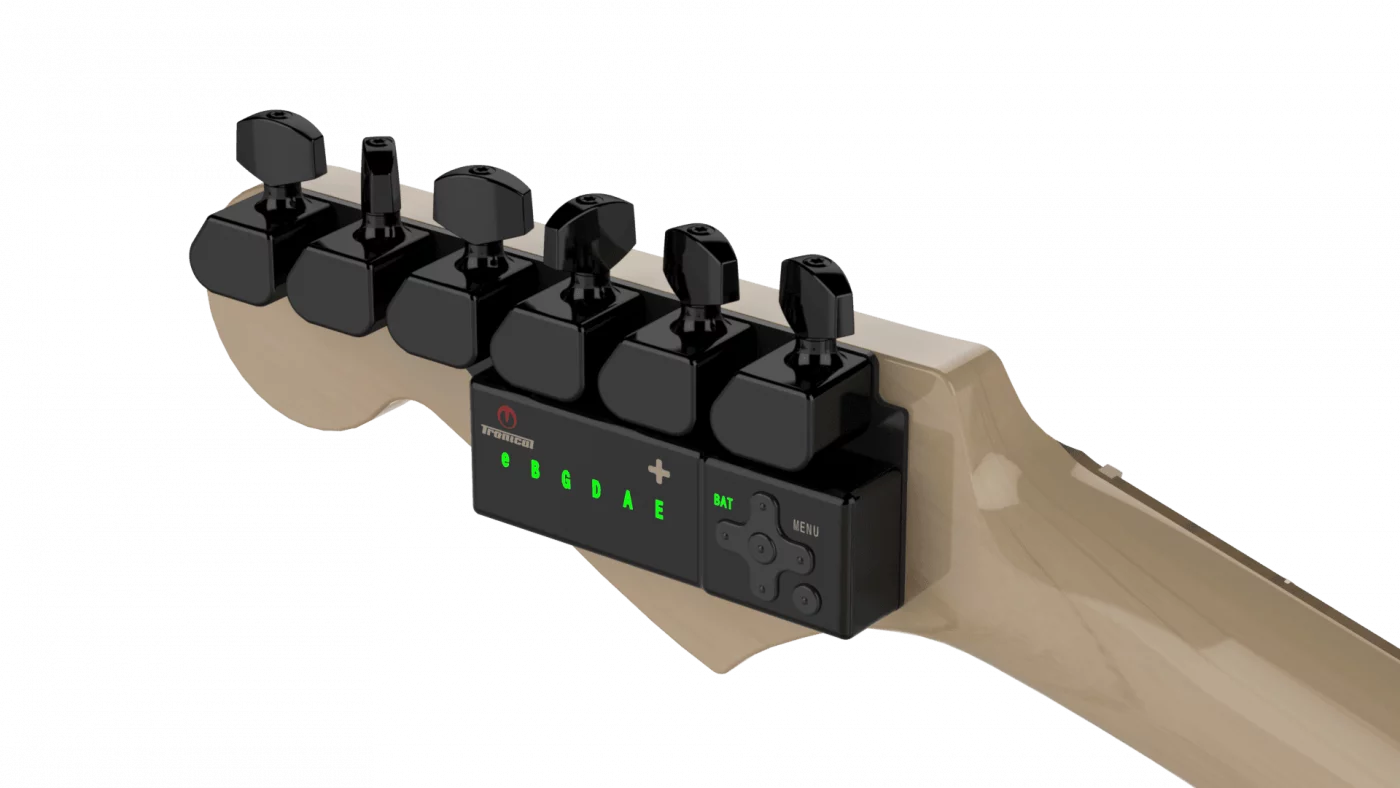
Strat headstock fit starts at the back
The front silhouette of a Strat-style headstock tells only part of the story. For an automatic system, the rear layout matters most because that is where the motorized machine heads and connecting board sit as one assembly. Two guitars can both have six inline tuners and a familiar outline, yet use different tuner footprints on the back.
A reliable check should cover all four of these points:
- All six tuner holesOne overall width measurement is not enough. Each hole has to align correctly with the system, not just the first and last.
- Mounting orientationSix-in-line, reverse, and left-handed layouts are not interchangeable. The direction of the headstock and hardware matters.
- PCB outline on the rearThe board that connects the tuners needs the right shape and position behind the headstock. This is why a guitar that looks similar from the front may still need a different template.
- Clearance around nearby hardwareString trees, washers, and the available space behind the headstock can all affect whether the assembly sits correctly.
That is why the safest next step is not guesswork but the official printable template. TronicalTune’s installation guidance asks you to verify the exact type before ordering and to make sure every tuner hole aligns with the PCB. You can check that process on the installation page.
Four checkpoints for a six-in-line guitar
If your guitar has six tuners in a row, these are the practical details to inspect before you buy.
1. Tuner-hole pattern
This is the main compatibility point. Fender itself notes that vintage and modern tuner systems can use different mounting-hole sizes, and that changing tuner types is not always a simple drop-in swap. That matters here because a partscaster, S-style copy, or even two Fender-family instruments may not share the same tuner layout even when their fronts look nearly identical.
For that reason, fit cannot be confirmed by brand name alone or by saying “it has six tuners on one side.” The exact hole pattern must match the intended system template.
2. Rear-headstock space
Motorized tuners need room behind the headstock. On many six-in-line guitars this space is straightforward, but not all rear surfaces are equally open. Small differences in washer placement, tuner body shape, or the outline near the tip of the headstock can matter once all six units are linked together.
This is also where the printable template helps more than a tape measure. It shows whether the full assembly footprint makes sense on your actual instrument, not just whether the tuner posts seem to line up.
3. String-tree position and string path
Traditional Fender-style flat headstocks often use string trees because the high strings travel farther from the nut to the tuning posts. On some guitars, staggered tuners reduce or remove that need, but many six-in-line headstocks still include one or more string trees. That does not automatically prevent installation, yet it is part of the layout you should pay attention to.
The key point is clearance and string path, not fear. Since string trees are a real contact point on many Strat-style guitars, they should be visible in fit photos and considered when you check how the installed hardware will sit around the back and along the front edge of the headstock.
4. Orientation of the specific guitar
Reverse and left-handed versions need special care. A six-in-line pattern by itself does not tell you whether the mounting orientation is correct. If the guitar is not a standard right-handed inline layout, do not assume a mirror image will work. Check the actual headstock orientation against the official template.
Why not every Strat-style guitar matches the same template
The phrase “Strat-style” is useful for describing the general shape, but it is not precise enough for installation. Even within the Fender world, tuning machines vary in hole diameter and mounting style. Once you include S-style guitars from Yamaha, Squier, parts builders, and other brands, the range gets wider.
That is why Strat headstock fit should be treated as a model-by-model question, not a style category. A six-in-line Fender Standard Strat may match one pattern, while a Yamaha Pacifica or another S-style guitar may require a different check. Both can be good candidates, but neither should be approved just by appearance.
This also explains why TronicalTune advises comparing all six holes, the full PCB outline, and the headstock orientation with a full-size template instead of relying on one dimension. Similar from the front does not always mean identical from the back.
In practice, the answer comes down to the exact rear layout rather than the familiar front silhouette.

What to do if your guitar is close but unclear
If your guitar appears to be a likely candidate, use the official fit-check process rather than trying to force a match. The best sequence is simple:
- Identify whether your guitar is a standard six-in-line, reverse, or left-handed layout.
- Print the official template at full size.
- Check all six tuner holes, not just the outer distance.
- Compare the rear-headstock outline and available space around the full assembly.
- Look at string-tree placement and general clearance.
If the match is still uncertain, use the dedicated fit-check help at how to check your automatic guitar tuner. TronicalTune also notes that when no standard PCB fits, a custom PCB may be possible for a specific hole layout if installation is feasible. That is a much better path than modifying the guitar to force a fit.
So, can you install an automatic tuner on a Strat-style six-in-line headstock without drilling? Yes, in many compatible cases. But the deciding factor is not the famous outline or the number of tuners in a row. It is the exact rear-headstock match. When Strat headstock fit is confirmed with the proper template, a no-drill installation can be realistic. When it is not confirmed, the right move is to pause, measure carefully, and ask support rather than assume.

Sources
- Guitar Tuner with Automatic Tuning | TronicalTune
- How TronicalTune Works | Automatic Guitar Tuner Technology
- Knowledge Base - Guitar Tuner Fully Automatic - Retrofit for Any Guitar | TronicalTune
- What Is a String Tree?
- How do I set up my Stratocaster® guitar properly? – Fender
- What are the differences between different types of Fender® Guitar Tuning Machines? – Fender
- What Are Tuning Pegs and Why Do You Need Them?
- TronicalTune Installation | Install Your Automatic Guitar Tuner