Guitar Care & Maintenance
Guitar Intonation Check: Before You Move the Saddles
Leave the screwdriver in its case for the first pass. A useful guitar intonation check starts with a comparison, not an adjustment. You want to know whether the same string behaves differently when it is open and when it is fretted, and whether that difference repeats.
That distinction can save an evening of aimless tweaking. Tuning an open string establishes its starting pitch. Intonation work concerns the pitches you get along the fretboard, with string length at the bridge among the relevant adjustments. Fender explains that relationship in its Intonation 101 guide.
The goal here is to collect a useful result before deciding what, if anything, to move. You do not need to turn a quick check into a complete home setup.

Give the comparison a fair starting point
Before measuring, ask what changed. A different string gauge? A new set that has barely been played? An action adjustment made last night? Write that down instead of treating the instrument as if nothing happened.
PRS's setup guidance places intonation late in the process, after neck relief, action, string stretching, and tuning. That is a useful reason not to set the saddles first when several parts of the setup still need attention. Its intonation instructions, updated June 12, 2026, make that order explicit.
Choose one tuner and keep its reference setting unchanged during the comparison. A chromatic guitar tuner with a cents display lets you inspect a fretted note as well as an open string. Play one note at a time, quiet the others, and let the initial attack settle before reading it. Those are also the operating recommendations for the TronicalTune browser tuner.
If you cannot get a repeatable reading, stop there. An uncertain measurement is not a good reason to make a permanent-looking change.
A guitar intonation check needs a fretted note
There are three sounds worth keeping separate: the open string, its 12th-fret harmonic, and the note fretted at the 12th fret. The last two should represent the same octave pitch, but they are not interchangeable tests.
Fender's method compares the harmonic with the fretted note. Merely sounding a clean harmonic leaves out the fretting comparison. A harmonic that looks right on the screen is therefore not, by itself, evidence that the fretted note is right too. This follows directly from the comparison Fender describes.
For your notes, use three plain labels: open, harmonic, fretted. Mark each result as centered, sharp, flat, or inconsistent. If the display provides cents, you can record those too, but do not give an unstable number more authority just because it has a decimal point.
Keep your normal fretting hand in the test
Do not adopt an unusually delicate grip just to make the display look better. Equally, do not squeeze much harder than you would in a song.
PRS recommends a regular playing grip for the fretted comparison. Its separate tuning-troubles guide explains that excessive finger pressure can pull notes sharp, especially with larger frets. That makes your hand part of the measurement, not an inconvenient detail to ignore.
A sensible follow-up is to fret the same note again with your usual touch. Does the result repeat? If changing your grip changes the reading substantially, make a note of that before blaming the saddle position. This is a suggested observation exercise, not a claim that a particular amount of finger pressure suits every player.
A direction is not a universal screw-turning recipe
For individually adjustable saddles, PRS gives the familiar direction: a sharp 12th-fret note calls for moving the saddle farther from the headstock; a flat note calls for moving it closer. It also specifies retuning and checking again after adjustment. The same page gives a different procedure for its stoptail bridge, which does not have six separate intonation adjustments. Follow the instructions for the actual bridge.
That is where a guitar intonation check ends and model-specific maintenance begins. A photo of somebody else's bridge is not enough to identify your adjustment screw. If you cannot identify the hardware, or something resists moving, leave it alone and consult a technician.
There is no reward for completing a setup without help. Bringing a clear observation to a repair appointment is already useful work.
Acoustic guitars need a different maintenance conversation
An acoustic guitar does not necessarily offer the sliding saddle pieces shown in electric-guitar tutorials. Taylor describes acoustic intonation work as part of a broader setup involving strings, action, neck relief, the nut, and the saddle. Its advice is to use a qualified technician for the necessary adjustments. See Taylor's acoustic intonation explanation.
You can still bring the results of your guitar intonation check. Describe which string is affected, what happens at the 12th fret, and whether the behavior began after a string or setup change. Do not sand a saddle simply because an electric-guitar video told you to move one backward.
Automatic tuning does not replace this comparison
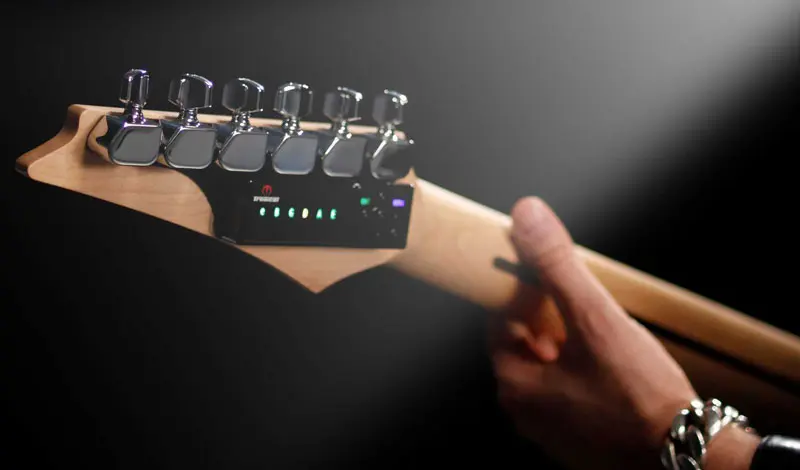
For TronicalTune owners, establish the intended open-string tuning using the procedure for your installed system. The TronicalTune online manual covers tuning modes and presets. Then check fretted pitches separately with a chromatic tuner.
An open-string tuning result and a fretted-note comparison answer different questions. Keep both in your guitar intonation check notes. Before changing hardware, you should be able to finish one specific sentence: "This string reads correctly open, but this fretted note repeatedly reads sharp or flat." If you cannot yet say that confidently, the next step is a better measurement, not another turn of a screw.