stage guitar tuner
Tuner Before or After Fuzz? Follow the Circuit
Put the tuner first. It is sensible advice until the fuzz pedal that sounded right yesterday stops responding the way you expect. Roll back the guitar's volume and, instead of cleaning up, the sound stays harsh. The new tuner might be working perfectly. Its buffer may simply be in the wrong place for that particular fuzz.
The question of tuner before or after fuzz is about more than getting a clear note on a screen. You are deciding what the fuzz receives while you play, what the guitar tuner receives while you tune, and where the sound gets muted.
Holeyboard brought this distinction back into focus in its September 6, 2026 article on fuzz placement. Its advice separates vintage-style, impedance-sensitive fuzzes from designs that tolerate a buffered input. That is a more useful starting point than treating every box labeled "fuzz" alike.

A clean tuning signal is still the goal
There is a good reason tuner pedals often sit at the front of a board. They receive the guitar before effects reshape the signal. BOSS makes that case in its pedal-order guide.
A tuner after an active pitch shifter may be measuring the shifted note. Delay can feed it earlier notes alongside the one you are playing now. Those are avoidable complications when the immediate job is checking a string.
But "give the tuner a clean signal" does not necessarily mean "keep a buffered tuner directly in front of every fuzz." You can put a sensitive fuzz first and bypass it while tuning. The playing path and the tuning routine need to be considered together.
What changes when the buffer stays on
Buffered bypass and true bypass describe what happens to the audio path when the pedal is bypassed. They are not grades of tuning accuracy.
As BOSS explains in its buffer guide, a buffer provides a low-impedance output that helps drive the cable and equipment after it. That can be useful with passive pickups and a long run of cable. True bypass does not make the remaining cable disappear.
This is why turning a tuner off with its footswitch may not remove its buffer. Check the model's bypass specification instead of assuming an inactive display means a direct connection.
The BOSS TU-3W is one concrete example of a tuner with selectable buffered or true-bypass operation. That is a routing option, not a reason every player needs a different tuner.
Why some fuzz circuits object
Analog Man specifically warns that vintage Fuzz Face and Rangemaster circuits can respond poorly to a buffer ahead of them. Its technical explanation describes a change in the way the effect cleans up with the guitar's volume control, and potentially a brittle sound.
The important symptom is a change in playing response, not a string suddenly moving out of tune. Moving the tuner can change the electrical interaction without changing the guitar's mechanical tuning.
Do not extend that warning to every modern fuzz. Holeyboard's article discusses more buffer-tolerant designs as well as updated versions of older circuits. The maker's instructions for your exact pedal matter more than its paint color, transistor marketing, or resemblance to a vintage enclosure.
Tuner before or after fuzz: choose a workable route
For an impedance-sensitive fuzz and a buffered tuner, a useful starting arrangement is:
Guitar -> sensitive fuzz -> tuner -> remaining effects -> amp.
Bypass the fuzz when checking pitch. Otherwise, solving its input preference may leave the tuner receiving a heavily processed signal. This arrangement is a practical application of the manufacturers' guidance, not a guarantee for every pedal combination.
If the tuner has a genuine true-bypass option, another arrangement worth checking is:
Guitar -> tuner in true bypass while playing -> sensitive fuzz -> remaining effects -> amp.
Make sure there is no other buffer between the guitar and the fuzz. A separate buffer or another buffered pedal ahead of both can defeat the reason for changing the tuner's setting.
For a fuzz whose manufacturer permits a buffered input, starting with the tuner first is reasonable. There is no benefit in creating an elaborate exception for a problem your circuit does not have.
A working display does not prove the rig is muted
Follow the cable that reaches the amplifier, not just the tuning meter.
On the BOSS TU-3W, the normal output mutes when tuning is engaged, while the separate BYPASS output remains unmuted. Similar-looking sockets can therefore produce very different results during a song break. Check your own model's manual rather than applying those jack labels universally.
Also distinguish muting the guitar input from silencing everything downstream. As a routing consequence, a tuner before a delay or looper does not necessarily stop audio that the later pedal is already producing. Test your actual rig, including stored loops and effect tails.
At a comfortable volume, engage the tuner, play a note, and listen at the amp. Then test the same action with the effects you use between songs. Do this before relying on that switch to make a guitar change quiet.
Automatic tuning solves a different part of the job
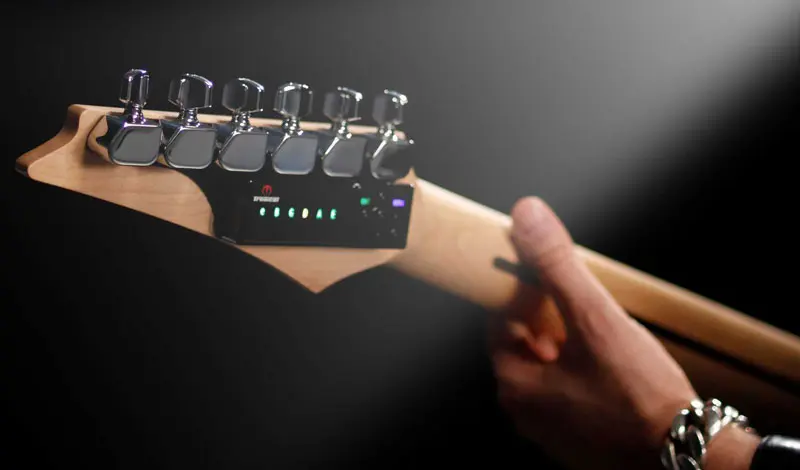
TronicalTune adjusts pitch by turning the guitar's motorized tuning heads, as the automatic tuning explanation describes. It is not a substitute for planning the pedalboard's mute path.
If you already use the system, consult the TronicalTune online manual for its tuning procedure, then check separately how your amplifier signal is silenced. Changing who turns the tuning heads does not remove the need for that check.
Keep the final decision concrete: does the fuzz respond correctly while playing, does the tuner receive a useful signal when needed, and does the intended output actually go quiet? Once those three things work, label the cables and keep the arrangement. A familiar rule should help you build the rig, not prevent you from fixing it.