Drop D Guitar Tuner
Drop D on a Floating Tremolo: 5 Practical Tips

Sep
Drop D on a floating tremolo can turn a one-string change into a six-string conversation. You lower the bottom E to D, play a chord, and something still sounds wrong. Check the other strings and several have moved, even though you never touched their tuning keys.
Your guitar tuner may be telling you the truth. On a floating bridge, the strings share a moving piece of hardware. Changing one string’s tension changes the balance that all six depend on.
The answer is not to keep chasing the low D in isolation. First identify the bridge setup, then give the whole guitar a chance to settle. These five checks make the process less frustrating.
1. Check the bridge before trying Drop D on a floating tremolo
A tremolo arm does not automatically mean a floating setup. Floyd Rose describes a floating bridge as one that allows both upward and downward pitch changes with the arm. A bridge resting against the body, or deliberately blocked, behaves differently. See the manufacturer’s floating-tremolo troubleshooting notes.
Identify what is actually on your guitar. A model name alone is not enough: a previous owner or technician may have changed its setup. If you are unsure, ask a guitar tech to identify the bridge and its intended resting position. Do not force the arm to find out.
Also look at the nut. A locking nut is not the same thing as locking tuning machines. With a double-locking bridge system, follow the manufacturer’s unlocking and tuning procedure before using the headstock keys. Fighting a clamped string with a tuning key is not a shortcut.
2. Give your guitar tuner all six strings to check
Drop D changes the sixth string by one whole step. The intended open-string notes, from lowest to highest, are:
| String | Standard | Drop D |
|---|---|---|
| 6 – lowest | E | D |
| 5 | A | A |
| 4 | D | D |
| 3 | G | G |
| 2 | B | B |
| 1 – highest | E | E |
That is not D standard, which lowers every string. Fender’s Drop D guide confirms the one-string change and the resulting note sequence.
On a floating bridge, however, “only one target note changes” does not mean “only one string needs attention.” Floyd Rose explains that changing one string’s pitch affects the others in the opposite direction. Lowering the sixth string can therefore leave the remaining strings sharp. Its string-tuning instructions call for repeated checks across the strings until the tuning and bridge position are correct.
For a manual check, work through D-A-D-G-B-E, then check the low D again. Use a consistent picking touch and keep pressure off the tremolo arm. Write down which strings move on the next pass; that is more useful than deciding the tuner is unreliable because yesterday’s adjustment changed today.
The TronicalTune chromatic guitar tuner gives you a note and cents display for checking individual strings. In chromatic mode, confirm the note name as well as the centered reading.
3. Know when retuning becomes a setup job
Drop D on a floating tremolo involves two checks: are the strings at the intended pitches, and is the bridge resting where this design requires it to rest?
Do not apply one bridge-angle rule to every guitar. Floyd Rose’s instructions specify a parallel baseplate for the system they describe. Fender’s Stratocaster setup guide describes a floating gap and also covers a flush-to-body option. The instructions are model-specific, not interchangeable.
If the bridge position has changed substantially, or the action now feels wrong, stop treating the problem as a bad tuner reading. Have the guitar set up for the tuning and strings you actually use. Do not start turning the truss rod or bridge pivots simply because an open string reads sharp.
A heavier bottom string is not an automatic requirement, either. D’Addario’s August 2026 Drop D guide notes that an existing string set can work, depending on the setup and feel. Try your present strings before buying a different gauge. If the low string feels too loose under your normal attack, discuss the complete setup with your tech.
4. Let automatic tuning handle pitch, not bridge setup

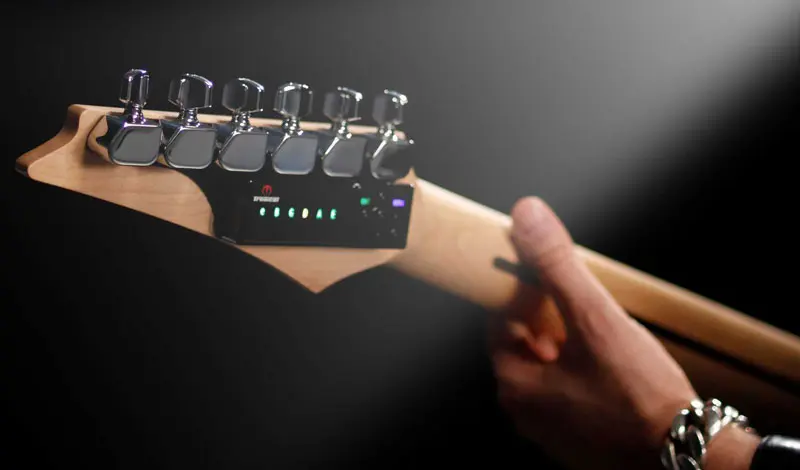
With a compatible TronicalTune installation, you can select a tuning preset rather than manually working through each tuning key. The TronicalTune online manual for firmware V. 3.56 lists Drop D among the factory presets. Follow the instructions for your installed system and let the tuning cycle finish.
There is an important distinction: automatic tuning changes string pitch; it does not adjust the tremolo springs or repair a worn bridge. Drop D on a floating tremolo still depends on a suitable mechanical setup.
Our TronicalTune knowledge base addresses tremolo use and recommends at least three springs. That recommendation is not permission to ignore your bridge manufacturer’s instructions. Check fit and the locking-nut arrangement before choosing a system, and ask support if anything is unclear.
The practical benefit is having the tuning adjustments handled for you on a suitable guitar. It is not a promise that any bridge can jump between any two tunings without preparation.
5. Rehearse the tuning change, not just the song
Work out Drop D on a floating tremolo before the audience is waiting. Try the exact transition you need: standard to Drop D, the opening riff, then back to standard. Use the guitar, strings, tuner, and picking style you will take to rehearsal. Check the whole tuning after each change, not just the string you lowered.
If the change interrupts the flow, give yourself another option. Group the Drop D songs together, allow a tuning break, or use a second guitar already prepared for that part of the set. Those are musical decisions, not admissions that your gear has failed.
For Drop D on a floating tremolo, the useful finish line is a repeatable transition and a guitar that plays comfortably afterward. Once that is sorted, stop watching the display and play the riff that made you want the low D in the first place.