stage guitar tuner
Clip-On vs Pedal Guitar Tuner: 5 Smart Tests for Loud Rooms

Sep
A loud rehearsal room is a bad place to discover that your tuner does not suit your rig. The drummer is checking the snare, the bass amp is humming, and somebody is testing a vocal microphone. Your low E string is moving on the display, but you are not sure whether the tuner is reading your guitar or the room.
The clip-on vs pedal guitar tuner decision comes down to how the tuner receives pitch information, what you need to mute, and where you can see the display. These five tests will tell you more than a long feature list.
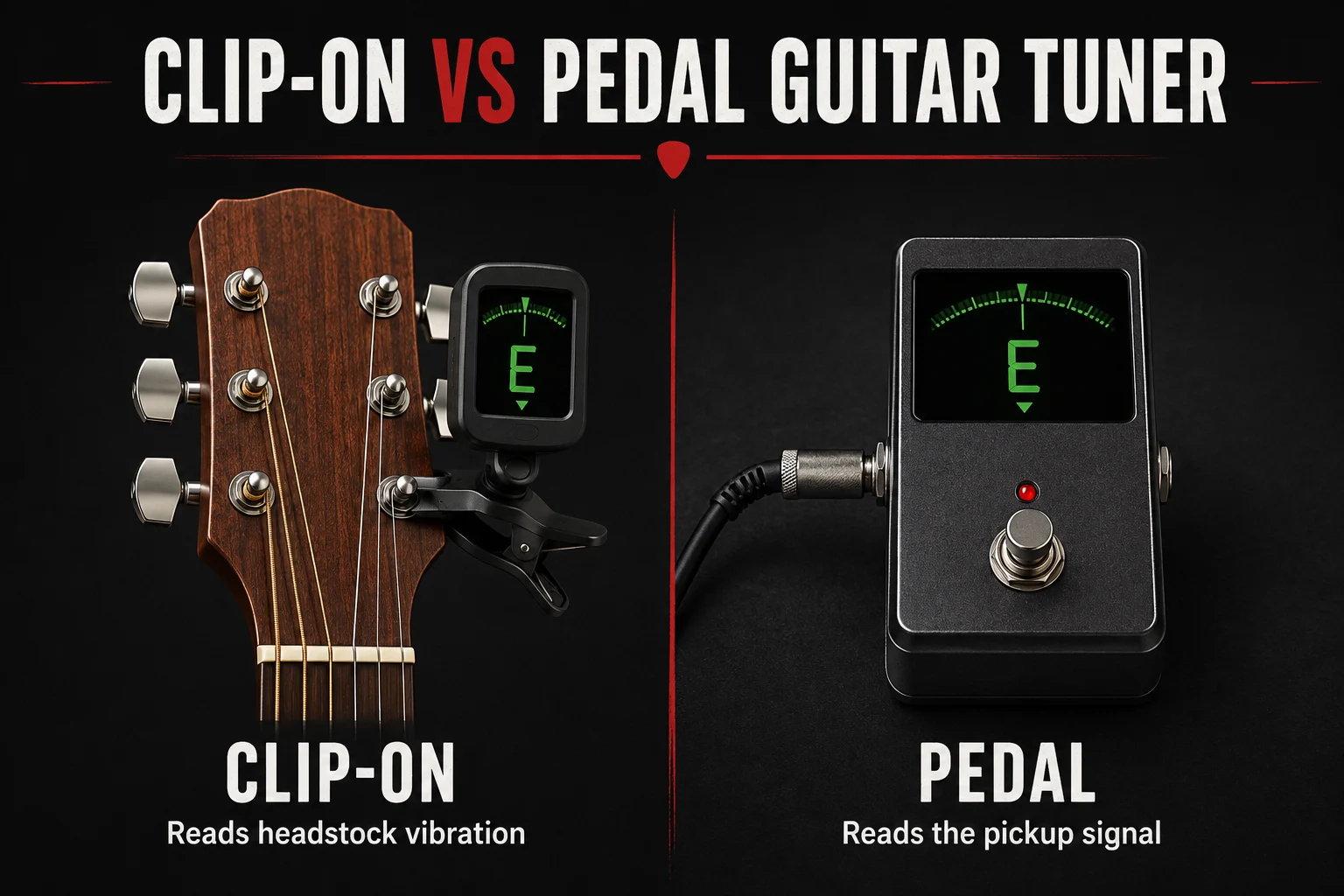
1. Follow the signal before comparing accuracy
A clip-on tuner normally reads mechanical vibration through the headstock. Fender describes its FT-1 Pro as using a built-in vibration sensor and says that this design is intended to work in noisy environments. The tuner does not need to hear the room through a microphone.
A pedal tuner receives the electrical signal from a pickup through a cable. That gives it a clean path in an electric rig. Room noise does not enter the tuner in the same way, although unwanted noise already present in the guitar signal can still matter.
This difference is more useful than a simple accuracy number. For a closer look at what the numbers mean, see our guide to guitar tuner accuracy. First ask how the note reaches the tuner. Then compare display resolution, modes, and published accuracy.
2. Decide whether silent tuning is essential
For many electric guitarists, muting is the strongest reason to choose a pedal. The BOSS TU-3 documentation specifies automatic muting when tuning is engaged. Use its OUTPUT connection for silent tuning; the separate BYPASS connection serves a different purpose. Check the routing before relying on any pedal to mute a live rig.
A clip-on is outside the audio path, so it cannot mute the amplifier. You need to lower the guitar volume, use a separate mute, or accept that the room may hear the process. That may be perfectly acceptable at rehearsal, but it is less convenient during a tight stage change.
The opposite is true for an acoustic guitar without a pickup. A conventional pedal needs a compatible electrical input, usually from a pickup; an unamplified guitar alone cannot feed its jack. A clip-on can move from the case to the headstock in seconds and does not require another cable.
3. Check the display from your real playing position
Visibility is not just a question of brightness. A pedal display may be easy to read when you are standing directly over it, but harder to see if the board is off to one side. A headstock display is closer to eye level, but its hinge must allow the screen to face you.
Outdoor stages create another problem. BOSS includes a high-brightness mode on the TU-3, while Fender highlights a backlit display and dual-hinge mounting on the FT-1 Pro. Those are manufacturer-specific features, not proof that every pedal or every clip-on behaves the same way.
Try the viewing angle you will actually use. Stand, wear the guitar at normal strap height, and look at the display under bright light. If you have to bend down or twist the headstock after every song, the format is working against you.
4. Count instruments, cables, and changeovers
A suitable clip-on can move between guitars and other instruments, provided its pitch range and clamp fit each one. That makes it attractive for a small rehearsal setup. The tradeoff is that it must be moved, switched on, and placed securely during each change.
A pedal stays ready on the board and is difficult to misplace. It works especially well when every instrument reaches the same pedalboard input. More complicated rigs may need an input selector, separate signal paths, or a second tuner.
There is also a third option for acoustic players. Korg's Rimpitch-C2 attaches inside a compatible round soundhole and senses vibration from the guitar body. Korg's fit specifications require a 100 mm soundhole with a tolerance of 3 mm, so it is a specialized solution rather than a universal clip-on replacement. Its position can be discreet and easy for the player to see.
5. Test the boring details before buying
Small practical details decide whether a tuner remains useful after the first week.
Check the reference-pitch range if you play with ensembles that do not use A = 440 Hz. Confirm that chromatic mode covers your alternate tunings. Look at the battery type, automatic shutoff, power-supply requirements, cable access, and whether the display can be read in sunlight.
For a pedal, check whether the bypass is buffered or true bypass and whether that choice fits the rest of the board. BOSS lists the TU-3 as buffered bypass. That is a design fact, not automatically an advantage or disadvantage. The effect depends on cable length, the other pedals, and the player's preference.
For a clip-on, check the contact surfaces and make sure the clamp suits the headstock shape. Remove it before putting the guitar in a tight case unless the manufacturer explicitly says the installed position is safe.
What about a phone or browser tuner?
A microphone-based tuner is useful when no dedicated hardware is nearby. It is a sensible backup for a practice room, hotel room, or workbench. TronicalTune's browser-based guitar tuner runs without adding a pedal or clip to the instrument.
In a loud rehearsal, however, a microphone hears the air around it. Move to a quieter corner, ask the band to pause, or connect a direct signal when the tool supports one. A phone tuner is convenient, but convenience does not change the signal path.
Where an automatic tuner fits
An automatic system belongs in a different category. A clip-on or pedal tuner tells the player whether a string is sharp or flat. An automatic guitar tuner can also apply the correction through its motorized tuning hardware. The official overview of how automatic guitar tuning works explains that workflow.
That does not make pedal and clip-on tuners irrelevant. Players may still keep one as a backup, use it to check another instrument, or prefer a familiar display during setup work. Anyone considering integrated hardware should first check which system fits the guitar.

Clip-on vs pedal guitar tuner: the practical verdict
Choose a clip-on when you want a compact tuner for acoustic instruments, a minimal rig, or quick movement between instruments. Choose a pedal when your guitar already runs through a pedalboard and silent tuning is important. Consider a soundhole tuner when you play a compatible acoustic and want the display close to your natural line of sight. Keep a microphone-based tuner as a useful backup, especially outside the loudest part of rehearsal.
The best choice is the one that receives a clean signal, stays visible, and fits the way you change instruments. Test those three things before chasing the smallest number in an accuracy specification.