Guitar Tuner
Guitar Tuner Accuracy: How Accurate Do You Really Need to Be?
Sep
A guitar tuner gives a simple answer: flat, sharp, or in tune. The number behind that answer is less simple. One tuner promises accuracy within one cent, another offers a fine or strobe mode measured in tenths of a cent, and a phone app may not publish an accuracy figure at all. How much of that difference can you hear, and how much actually matters when you play?
For everyday guitar tuning, a clear and stable reading is usually more useful than chasing the smallest possible number. Extra precision becomes valuable for intonation work, layered studio parts, and instruments that expose tiny pitch differences. The key is knowing what your guitar tuner measures—and what it cannot fix.
What guitar tuner accuracy means
Pitch differences are commonly measured in cents. A semitone—the distance from one fret to the next—is divided into 100 cents. An octave contains 1,200 cents. Because cents describe a musical interval rather than a fixed number of hertz, the same scale works across the entire guitar.
If a manufacturer specifies a guitar tuner accuracy of ±1 cent, it means the measured pitch can be within one cent above or below the actual value under the stated test conditions. That is already a small fraction of the distance between two neighboring notes.
Accuracy is not the same as display resolution. A screen can show very small steps without the complete device measuring them reliably. Response speed is another separate quality. A tuner may be accurate on a steady laboratory signal but slow to follow a guitar string whose pitch moves immediately after the pick attack.
Is ±1 cent accurate enough for a guitar tuner?
For normal practice, rehearsal, and stage use, ±1 cent is a sensible professional reference point. The widely used BOSS TU-3 specifies ±1 cent accuracy. KORG lists the same figure for conventional models such as its Rimpitch acoustic guitar tuner.
More sensitive modes are useful when the job changes. KORG specifies ±0.1 cent for the PitchCrow-G in fine-tuning mode, and dedicated strobe tuners are designed to make very small movement visible. That additional detail helps when setting bridge saddles, comparing a fretted note with a harmonic, or checking a studio instrument before recording several doubled parts.
It does not follow that every string must sit motionless at one tenth of a cent before you can play. A real string is not a fixed signal generator. Its pitch rises slightly at the attack, settles as it sustains, and changes with picking force and finger pressure. A hyper-sensitive display can show that movement more clearly, but it cannot remove it.
Why a green reading can still produce a bad chord
A guitar tuner measures the note it receives. It does not automatically know whether the nut is binding, a string is worn, the bridge is moving, or the player is pressing too hard. This is why six correctly tuned open strings can still form a chord that sounds wrong.
Intonation is the first thing to check when notes become progressively sharp or flat farther up the neck. Compare the 12th-fret harmonic with the fretted 12th-fret note. Fender’s intonation guide explains the basic correction: lengthen the string when the fretted note is sharp and shorten it when the fretted note is flat.
Other common causes include fresh strings that have not settled, overlapping wraps at a tuning post, friction in a nut slot, excessive capo pressure, and a floating tremolo that changes position while the strings are tuned. Our guide to a guitar that still sounds out of tune walks through those mechanical checks in detail.
The signal matters as much as the specification
Even an excellent guitar tuner needs a clean signal. Background sound can confuse a microphone-based app. A clip-on tuner reads vibration through the headstock and is less affected by room noise, but its response can change with placement and with the strength of the vibration. A pedal receives the pickup signal directly, which is useful on a loud stage.
For the most repeatable result, use the neck pickup if your guitar has magnetic pickups, reduce effects and distortion, and pluck one string cleanly. Let the initial attack pass for a moment before making the final adjustment. Fender likewise recommends that you allow the note to sustain and give the tuner time to hear the change.
Always check the reference pitch as well. Standard guitar tuning normally uses A4 = 440 Hz. Many tuners allow calibration to other values; the BOSS TU-3, for example, supports A4 from 436 to 445 Hz. An accidentally changed reference can leave every string consistently sharp or flat compared with the rest of the band while the display still says “in tune.”
Clip-on, pedal, app, strobe, or automatic guitar tuner?
Phone or web tuner
A microphone tuner is convenient for a quick check at home. It needs no hardware, but room noise and the quality of the phone microphone affect the reading. It is less dependable beside drums, conversation, or another instrument.
Clip-on guitar tuner
A clip-on is compact and reads the vibration of the instrument. It works with acoustic and electric guitars without a cable. Good placement and a solid connection to the headstock matter, especially on a quiet or heavily damped string.
Pedal tuner
A pedal tuner gets a direct electrical signal and can mute the output while tuning. That combination makes it practical on stage. Its display must also be easy to read under bright lights; usable accuracy includes being able to see and react to the result.
Strobe tuner
A strobe display makes very small pitch movement obvious. It is the strongest choice for setup and intonation work, although the moving display can feel overly sensitive when all you need is a fast check between songs.
Automatic guitar tuner
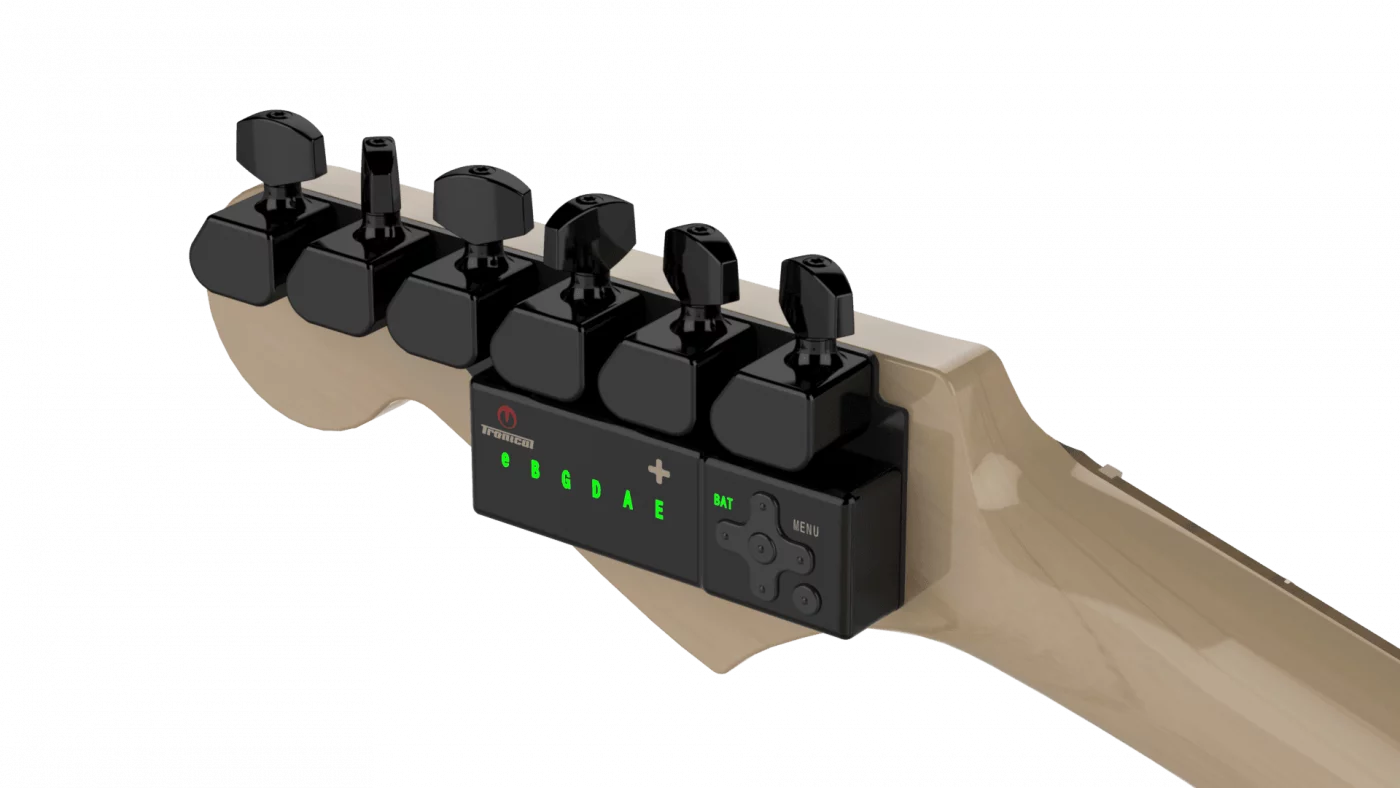
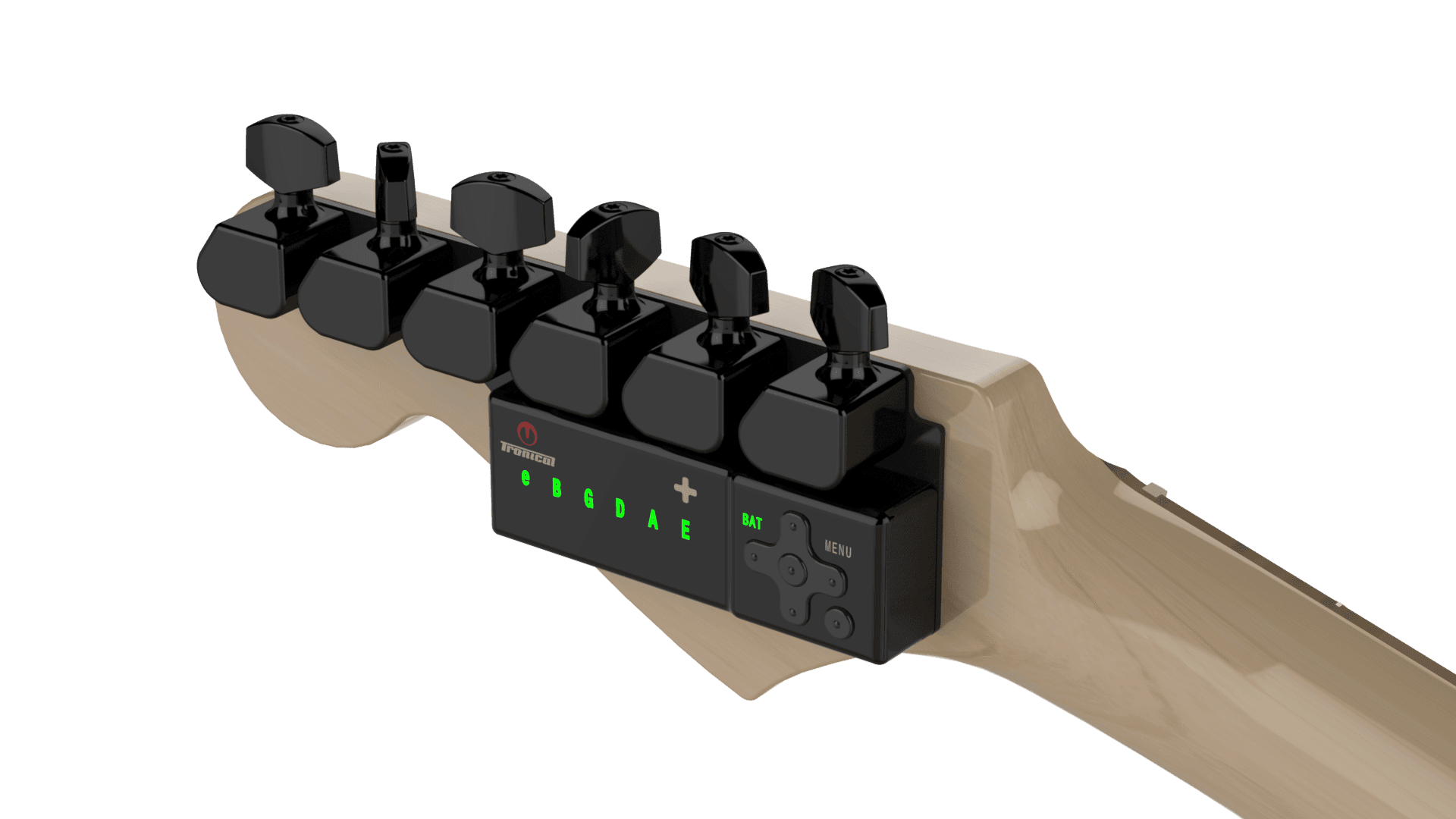
An automatic guitar tuner goes one step further. It measures the strings, calculates the correction, turns the machine heads, and checks the result. With TronicalTune firmware 3.56, standard, drop, open, and custom tunings are available directly on the guitar. The advantage is not only measurement accuracy; the correction is applied consistently across all six strings.
When extra guitar tuner precision matters
Use a high-resolution or strobe mode when setting intonation, recording layered guitar parts, preparing a 12-string guitar, or matching instruments that must share a non-standard reference pitch. In those situations, small differences can accumulate and become more obvious.
For a normal rehearsal or live set, speed, visibility, signal stability, and repeatability may matter more than another decimal place in the specification. A tuner that reacts predictably in the actual room is more useful than a laboratory-accurate device that jumps between overtones or cannot be read on stage.
A reliable guitar tuning routine
- Confirm the reference pitch is A4 = 440 Hz unless the session requires another standard.
- Remove heavy effects and give the tuner the cleanest signal available.
- Pluck with a consistent, moderate attack and allow the note to settle.
- Approach the target pitch from below so the string finishes under normal tension.
- Check all six strings again after the first pass, especially with a floating bridge.
- Play a familiar chord and compare notes higher on the neck.
- If one string keeps drifting, inspect the string, nut, winding, and bridge rather than blaming the tuner.
The practical answer
A good guitar tuner does not need the longest specification sheet. For most playing situations, ±1 cent accuracy with a stable signal and a readable display is an excellent working standard. Finer resolution earns its place during setup and detailed studio work.
The guitar remains part of the measurement. Strings move, players apply pressure, and hardware creates friction. Reliable tuning comes from combining an accurate tool with a consistent routine and a properly set up instrument.
If you want the tuner to make the correction as well as measure it, explore how the TronicalTune automatic guitar tuner works. Before choosing a system, use the Guitar List or the 100% fitting templates to identify the correct type for your headstock.