Guitar Care & Maintenance
Why Your Capo Pulls the Guitar Sharp

Sep
Tommy Emmanuel recently brought an ordinary stage accessory back into the tuning conversation: the capo. In a demonstration covered by Guitar World on September 7, 2026, he emphasized careful placement rather than treating the clamp as something you can throw onto the neck and forget. Guitar World's report is worth a look for that performance perspective.
It also raises a useful question: when a capo pulls the guitar sharp, should you reach for the tuning keys or start again with the capo?
Start with the capo. A tuning adjustment might still be necessary, but it should come after checking the thing that just changed. Otherwise, you can end up correcting a placement problem with six separate tuning adjustments.
A capo is not supposed to preserve the old note names
First, separate two different meanings of "sharp." A capo intentionally raises the sounding pitch. On a guitar in standard tuning, putting a full capo at the second fret changes the unfretted string notes from E-A-D-G-B-E to F#-B-E-A-C#-F#, low to high. That is normal transposition, not a tuning fault.
The fault is a note sitting above its new target. Your low string should now sound F#. If the tuner identifies F# but shows it above center, the string is sharp relative to that intended note. If it simply says F#, nothing has necessarily gone wrong.
This is where a chromatic guitar tuner helps: it identifies the sounding note rather than assuming that the sixth string must still be E. The TronicalTune chromatic tuner provides a note name and cents display. Check both. Do not lower every capoed string back to its original open-string note; that would change the tuning rather than verify the transposition.
When a capo pulls the guitar sharp, check the squeeze
The clamp has to press the strings firmly enough to fret them. More pressure is not automatically better. Shubb's capo FAQ explains the tradeoff: excessive pressure can raise pitch, while insufficient pressure can leave strings buzzing. It also identifies fretboard curvature as a factor in distributing that pressure evenly.
G7th makes a related point in its explanation of capo fit: string gauge, action height, fretboard radius, and pressure distribution can all affect the result. These are manufacturers explaining the problem their products address, not independent proof that one brand will stay perfectly in tune on every guitar.
For an adjustable capo, aim for clean notes with no unnecessary squeeze. Follow its instructions when changing the setting. For a fixed-pressure model, placement still deserves attention; squeezing the handle harder before releasing it is not the same as having an adjustable clamping force.
A useful buying question is therefore not just "How quickly can I attach it?" Ask whether the design suits your neck and lets you get an even, clean result where you actually use it. A capo that behaves well on one guitar does not establish how it will behave on another.
Put it down straight before touching the tuners
Shubb's placement instructions recommend positioning the bar near the fret on the headstock side, parallel to the fret, without dragging the strings sideways. Its lever-closing instructions are specific to its design; the broader check is whether the strings stayed aligned as you attached your own capo.
Look at the strings instead of judging only by how straight the handle appears. Is every string covered? Did one get nudged sideways? Does the capo leave room for your fretting hand? Release and reposition it if something looks wrong, then listen again before making a tuning correction.
If a capo pulls the guitar sharp repeatedly, compare placements on one guitar at one fret, using the same chord. Tune without the capo, attach it carefully, and check the resulting notes. Repeat that placement once before changing anything else. You are looking for repeatability, not trying to win an argument with the display.
This comparison is a suggested troubleshooting exercise, not a measured product test. If the result changes noticeably between placements, attachment technique is worth investigating before blaming the tuning machines.
Automatic tuning needs the right capo procedure

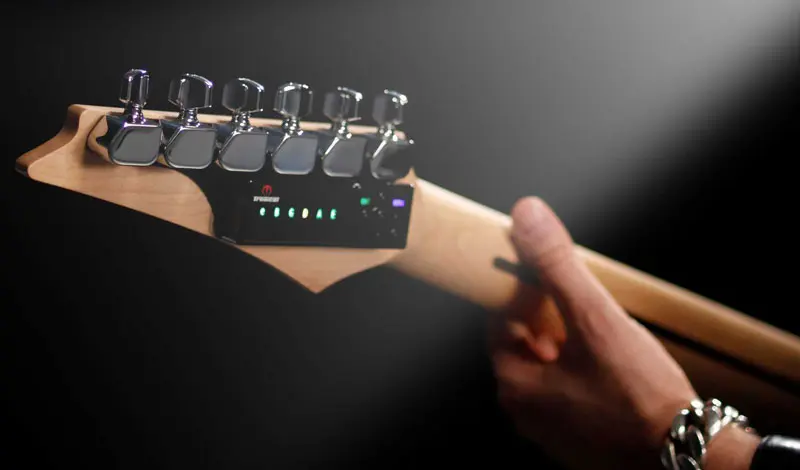
If a capo pulls the guitar sharp on a TronicalTune-equipped guitar, follow the capo instructions for your installed system before starting a tuning cycle.
The current TronicalTune online manual describes Capo Mode for positions at frets 1 through 6. It instructs the player to finish the desired base tuning and switch off before attaching the capo. The subsequent Capo Mode sequence detects the position and tunes relative to it. Consult the illustrated instructions for the button sequence and display feedback.
That is a defined operating range, not a claim about every fret or every partial-capo arrangement. The mode also does not remove the need to fit the capo carefully. Software knowing which notes to target and a clamp applying sensible pressure are separate parts of the job.
Listen to the part you are about to play
A useful final check is the actual opening of the song, not a random chord chosen because it sounds reassuring. Play the voicing, bass notes, or fingerpicked figure you need, at your normal touch. If something still bothers you, identify the string and note before changing another setting.
If the capo pulls the guitar sharp again, keep a short note: which guitar, which fret, which string, and whether repositioning changed it. That gives a repair technician something concrete to examine if careful placement does not resolve the issue. It is more informative than asking for a general fix because "capos never work on this guitar."
The practical takeaway from the renewed discussion is modest: make capo placement part of tuning, not an afterthought. Before the next rehearsal, spend a few minutes finding a placement you can repeat. Then you can make any remaining pitch correction deliberately, instead of starting the song by guessing which piece of gear let you down.